
Cable-ties, weak-ties, relational tech and going bananas

Cable-ties, weak-ties, relational tech and going bananas
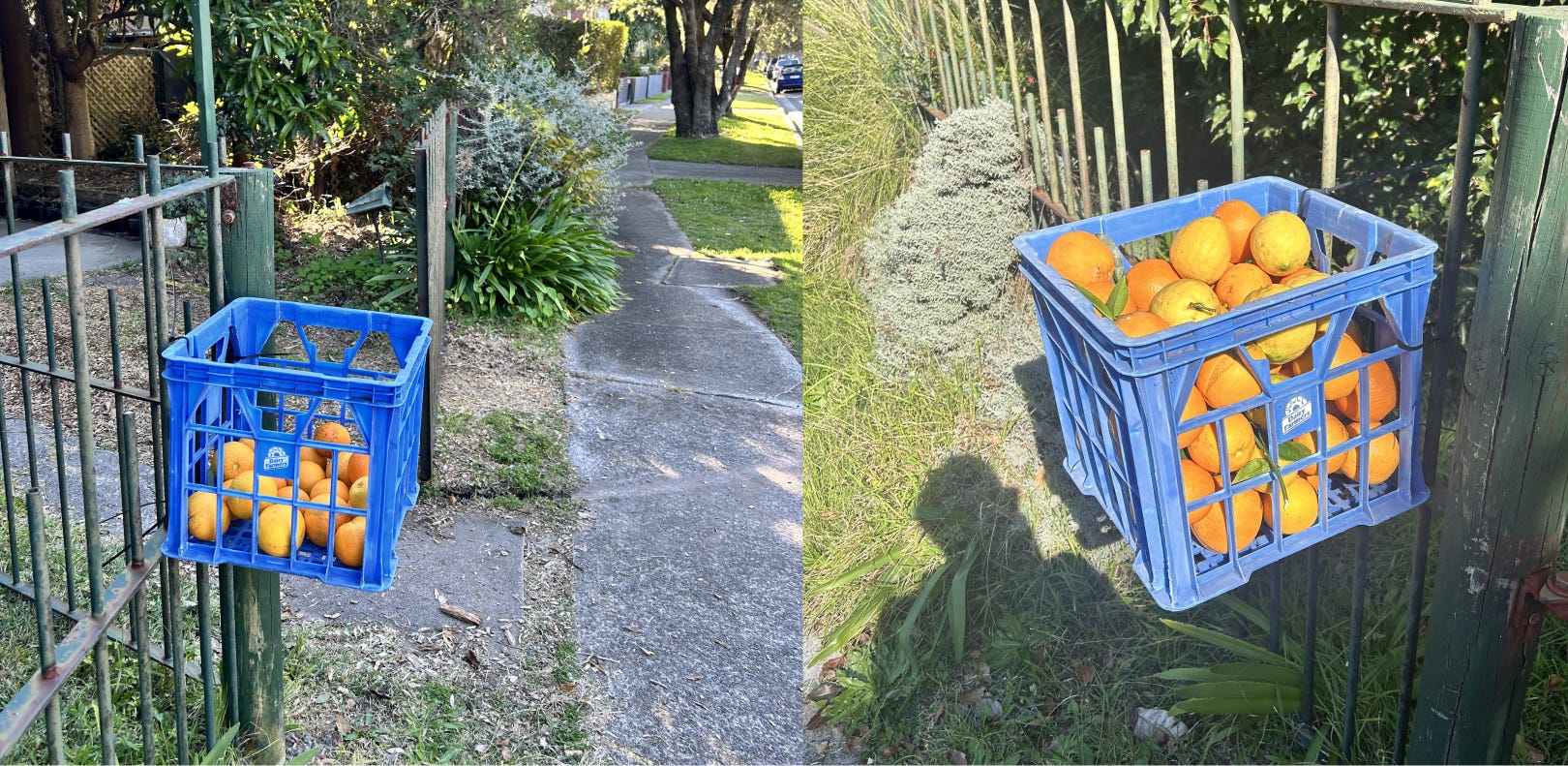
A milk crate has been cable-tied to my front fence for five years.
I hung it there in 2021, during one of Sydney’s pandemic lockdowns. We have three orange trees producing more than the household can use, and people walk past every day. And at that time, people were actually out walking more because many were not out at work. The arrangement was simple. I picked the surplus with the kids, put it in the crate, and let the passers-by take what they wanted. No sign. No instructions. No record of who took what. The cable ties were the only piece of governance. One time I noticed a person loading their bag up, taking a dozen or so. I didn’t stop them.
A neighbour would walk by regularly with his young daughter. Back then she was in a stroller, now she is older and walks beside him. She really loves the oranges. They put an avocado in the letter box, with a note written by the young girl, just saying, thanks.
The crate is still there. The plastic has weathered. I’ve had to replace the cable ties once. The fruit changes with the season. Oranges in winter, lemons spilling into spring, bananas and mangoes through summer when the harvest is larger than what we can eat, which is basically every season. This morning I dropped a bunch of bananas in. By evening some of them will be gone. I won’t know who took them, and it’s likely they won’t know who put them there, and that is part of the point.
I was in calls this week with bankers and fintech people. We were talking about the social purpose of money, the contexts in which its functions evolved, the way it operates as a unit of account, a medium of exchange, a store of value, a social licence to make claims on other people’s labour, a memory of obligation, a discipline against free-riding. All of these are real. The physical and institutional infrastructure that maintains them is real. Anyone who tells you the whole edifice can be replaced is either selling something or hasn’t yet had to make payroll.
And yet…
The crate has been running for five years on no tangible infrastructure at all. No ledger, no protocol, no governance overhead. The transaction cost is roughly zero. The trust assumption is that my neighbours will leave it alone or take from it as needed, which has so far held. The crate solves a real coordination problem. What to do with surplus harvest when the household can’t consume it. The substrate it runs on is older than money and has never gone away.
What the crate produces, mostly, is weak ties. Low-stakes, reasonably high-frequency, asynchronous touches between people who share a street, a neighbourhood, a local ecology. Most of the takers I have not and will likely never meet. Some I have nodded to, and/or shared a brief greeting and a smile in passing. None of them owe me anything, and none of them owe each other anything either. The arrangement keeps a piece of relational tissue slightly more alive than it would otherwise be. That’s the whole effect. It’s enough.
This is the thing I keep coming back to. The technologies we build for connection often reach past this deeper relational register. They want strong ties, deep engagement, persistent identity, full participation. Flywheels. They want the ledger. They want the graph and you as the node. They want every interaction to be legible, measurable, optimisable, verifiable. The relational fabric of an actual neighbourhood operates at a different scale entirely. It is smaller, more ambient, and with mostly-anonymous traffic. People noticing each other in passing, leaving and taking small things, knowing without being told that the street is held by people who are paying attention. The crate runs at that scale. And I sense anything more elaborate would diminish it. I’ve tried. The crate “just works”.
I have, over the years, written and said and believed a lot of grand things. Grand stories about transformation, multi-scale coordination infrastructure, about what comes after, about the architecture of the world many of us are building. Some of it I still stand by. Some of it I have walked back through in my theatre of moral imagination, quietly, because the lived shape of things turned out to be different from the story I was seemingly telling about them. I don’t dismiss the kind of knowing that comes from seeing and sensing the meta view. There is also the kind of knowing that comes from cable tying a crate to a fence post and watching what happens for five years. Both are real. They do different work, and they are answerable to different things.
If you are looking for the smallest possible experiment in something that resembles a different way of being together, you might already be running one. The babysitting circle. The tools borrowed and not returned but also not really tracked. The meals dropped off when someone is sick. The gift of a few bucks to someone in the street. The lift to the airport. The hour spent helping a friend move house. The time reviewing that friends draft research paper. Count what came to you this week that didn’t route through money. Count what you might have given the same way. Most of us will be surprised by the answer, some won’t. But that surprise is the visceral hit. The surprise comes from something already there becoming, for a moment, perceptible, and likely preferable at larger scale.
It can seem like the world is going bananas. The absurdity we are living amongst, and within, is a ripening of sorts and the Orangutang that is Trump waging war, he is certainly bananas. Things that have been green and held tight to the stem are starting to give, and I don’t know what will be the catalyst for cascading failures. But some of what’s coming will be sweet. Some of it will go past sweet to fermented, and then to compost, and then to soil for whatever grows next. Bananas don’t actually ripen on a schedule you can vote on with a governance token. They ripen when the conditions are right, all at once, and the stewards of this harvest either have a plan for the surplus or don’t.
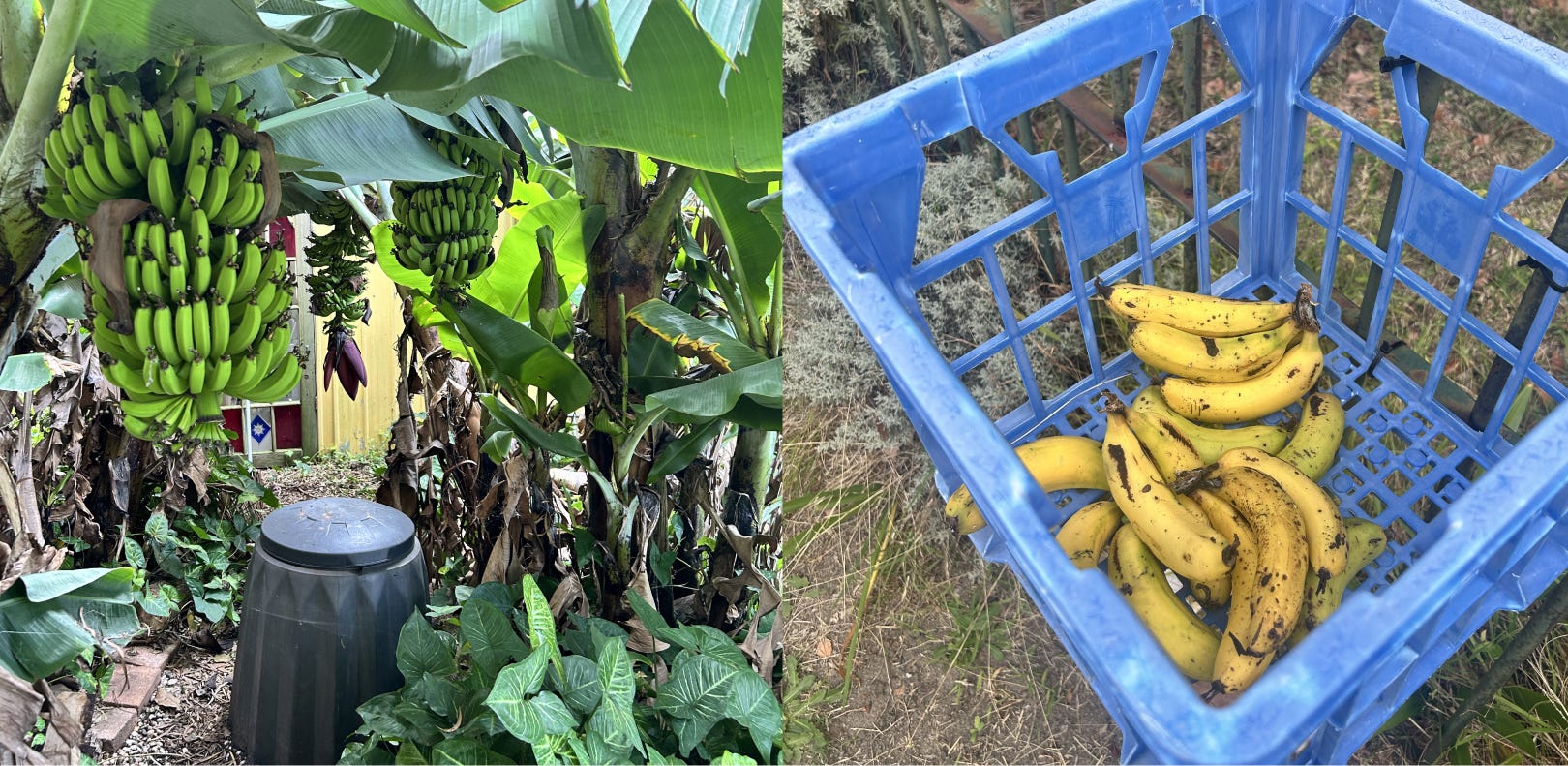
The crate is on the fence. The bananas are in the crate. Someone could be walking past right now and there is no explicit ledger that needs to know.
Thank you for this reminder that relational fabric comes in many shapes and forms and that small is beautiful.